Showing posts with label Entertainment. Show all posts

Friday, July 17, 2015

Kaguwa, Oiran-Za, and The Courtesan Dance of Today

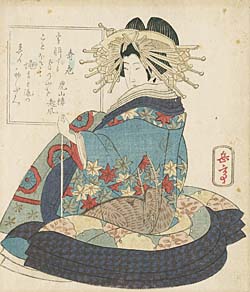
http://www.bates.edu/Images/Macko_Pipe72.jpgBefore Geisha rose into prominence in Edo, the ancient capital of Japan, Oiran were the most sought-after type of courtesan. Times were different, then; and it was a standard to employ courtesans for entertainment. But Oiran differed from Geisha in that the former dressed extravagantly, with hairstyles to match, whereas the latter were often more modest in their demeanor. This later on became the downfall of Oiran, who became associated with the dwindling top bracket of society, whereas the Geisha culture would continue to strive within the middle-class. Traditional Oiran can still be found in Kyoto today, but this article isn't about that.

 While routinely searching for things to do while out and about in Tokyo, I stumbled upon a venue which aimed to resurrect the art of Oiran while modernizing it. And though the place in question, named Kaguwa, in Roppongi, is nowhere as popular with tourists as, say, the Robot Restaurant in Shinjuku, the performance delivered there is quite something to behold.
 With its 3500¥ admission fee and one-drink, one-food policy, Kaguwa isn't exactly cheap, but the moment you enter, you get a pretty good idea of what you're paying for. The venue itself doesn't seat such a ludicrous amount of people - the stage upon which the dancers perform is quite close. Prior to the show's start, the dancers, resplendent in ornate kimonos, mingle freely with the patrons, sharing their business cards and giving their thanks.
 But when the show begins, it's a whirlwind of dazzling lights, a shifting stage and dance performances both powerful and graceful. The opening act of the one hour show was everything I had expected of Kaguwa's fabled modernized Oiran-za, and felt as authentic as it was mystifying, closing with the two lead dancers hooking themselves up to cables and flying off the stage, like some kind of Broadway production of Crouching Tiger, Hidden Dragon.

Except for the curtain-call, pictures were sadly forbidden.
But the show then proceeded to deliver a couple of performances I did not expect. Every subsequent act was completely different from the last - flowing from the aforementioned first act to a very strange and upbeat take on Ricky Martin's Vida Loca to acrobatic swordplay to appearances from famous manga characters to a strong closing act in the same vein as the opening one. Kaguwa's Oiran-za transitioned from captivating, to exciting, to bizarre, to sexy, to emotional, and was often a blend of several of those things at once. I had the strong feeling, throughout, that I'd probably miss something if I blinked.
 In a way that harkens, intentionally or not, to the ancient courtesan-culture, patrons graced the performers with money at the end of the show, holding out money for the performers to receive. It was at that point, too, that we were revealed which were actually women and which were transvestites. Whoa.
 Altogether, my hour had gone by way too fast, and I found myself wishing the show was twice as long. But it was an amazing rush, and my friends agreed that it was worth the money we had spent, and exceeded expectations.

Thursday, December 18, 2014

Damn, Momotaro

Japan has its fair share of folklore tales, but one of the most widespread and well known stories is that of Momotaro, the Peach Boy.
A story panel of Momotaro.
The tale is fairly simple. In short, an elderly couple find a peach floating down a canal. When they take it home to eat it, they find a boy inside, who explains to them that he was sent down to earth from heaven to be their son. They name the boy Momotaro (Peach "Taro", a name meaning firstborn son.) The child grows older, then hears of a band of oni (Japanese ogres) who weave destruction where they go. He sets out to defeat them, and along the way, befriends a dog, an ape, and a pheasant, who accompany him on his quest. Together, they travel to the island of demons, and force a surrender out of the oni.

 It's a personal favorite of mine, but in truth, I wanted to share that because Pepsi (yeah, the drink) have been releasing these amazing commercials, retelling the story. Shameless advertisement, ahoy! Here we go!

The original, "Episode 0" commercial, tells a part of the original story, with Momotaro assembling his companions.


The other episodes add to the story, with episode 1 having Momotaro learning swordplay from the master swordsman Miyamoto Musashi, the wandering swordsman who wrote the Book of Five Rings.


Episode 2 tells the story of Dog, who, in this retelling, was a boy raised by wolves. His wolf pack is one day killed by the oni, and the boy's hair turns white from grief. From then on, he calls himself "Dog."


I really thought the commercials have great impact and are lots of fun to watch. And I'm usually so tuned out when it comes to Japanese TV. Great character design, great music, a fun twist on the original story. I'll be staying tuned for more.

Tuesday, June 17, 2014

Interesting Tidbits: Japanese Television

I remember setting foot in Tokyo for the very first time, and the adrenaline rush of walking into the outside air and not knowing anything. I didn't even know the directions to my hotel, New Koyo, and just threw the address to a cab driver, and it all worked out. I collapsed upon the hotel futon, and turned on the room's small television.
 And, lo and behold, what came on was wrestling amongst the disabled. The blind versus the man with one arm! And so on. I was amazed at the censor-less entertainment.
 Some clips from Japanese television shows went viral in North America. Quirky game shows that look like something out of a video game, or terrible pranks that would get people sued on spot. Here are some examples, just for good measure. The former, then the latter.


Wow, you would think. Going by these, Japanese television would kind of be the pinnacle of entertainment.
Actually, and, rather unfortunately, for the most part Japanese television is...pretty normal. And normal television, regardless of where you are, is pretty boring.
Even just flipping through the channels, you can't help but notice almost trope-like similarities in the programming. Television here has its own set of rules. Here, let me turn my television on right now and give you a good example.

REACTION SHOTS: Look at the picture to the right. Notice the faces in the corner; those are people who are famous to at least some extent. During a segment, a live feed of their reaction as they watch the same thing you're watching is visible in a corner.
 My take of it is that, in Japanese culture, the norm is to do what other people do and think what other people think, at least to some extent.
And having someone else's reaction within sight kind of gives you an idea of what your own should be? It's a guess, and yours is as good as mine. Otherwise, reaction shots are pretty useless.
BIG, COLORFUL SETS: Even the blaaaaandest of talk shows is decked out in useless colorful trinkets and flamboyant furniture. It gives this really candy-like look to all the sets. "Hey!" it screams at your eyes. "Stop flipping the channels!"
OVERUSE OF CAPTIONS: For emphatic purposes as well. Notice both pictures have this big bold font right where you can see it. That font isn't providing you any real information, actually. It literally repeats what the person speaking just said. God, how aggressive!
OVER-ACTED EVERYTHING:
Whether it be a talk show or a drama, everything on Japanese television is frighteningly overacted - at least to my western tastes. Talk show hosts blow up their reactions to the slightest surprise - "WHOOAAAA!" and "EEEEHH!!?" are the kind of thing you're likely to hear six times a minute.
Most of the drama shows also lack in subtlety, with audible, campy music tracks and overplayed crying and anger scenes and cartoon-like expressions. Whereas I feel like all dramas in western television have entered an age of gritty realism where everything has to be cold and serious, Japan's stuck in the early 90's, but with HD.

 D'aww, I didn't mean to disillusion you about how entertaining Japanese TV is. Once in a while you do get something genuinely entertaining. Like that one time they created a living room half-made of sweets and made people try to eat what they thought was fake!


-What do you like to do in kindergarten?
- Poop...
I can't claim to be an expert on Japanese television at all, and without the outside perspective, it's hard to tell whether, to the eyes of a foreigner, western television falls into such redundant tropes as well. But for the most part, it took me a very short time to lose all interest in Japanese TV.
 I have the basic set of channels offered by cable now, and that's free, thank God, but I can count the total hours I've spent watching television on the fingers on one hand. It just ain't for me!

Friday, April 25, 2014

Dancers, Robots, and Dancing Robots

As far as unique attractions go within Tokyo, this one's been tugging at my sleeve for a while. At the steep price of 6000¥ per entry, Robot Restaurant in Shinjuku isn't cheap, and I thought for certain it was merely a very high-budget themed restaurant, where the waitresses serve the customers while piloting robots. Neat, but you can imagine I wasn't keen on the price.
 Thankfully, I was wrong. Robot Restaurant is much more than restaurant with a theme. Actually, food is more of an afterthought, even. Robot Restaurant delivers a show rather than a meal, and it's much more like a circus act than any kind of actual dining establishment.
 If you're looking for a place like the others, where odd assortments of food are brought to you from a theme-specific menu, you won't find what you're looking for here.
 But I can tell what you will get is a performance unlike any other you can find in the world.

Before I even get started about the show itself, it's important to bare one thing in mind which I myself hadn't figured would be of any importance before stepping in.
Robot Restaurant is in Kabukicho. That's the red light district of Tokyo, a fact I would've almost forgotten if men in suits hadn't stopped Basil and I in the middle of the street, while saying "wait, wait! Look, sex!" while showing us brothel catalogs.
 The show has a distinctive Kabukicho twist to it, in that the robots are really only half of what draws the crowd in. The "Gira Gira Girls", a small army of scantily clad young women with a multitude of talents, are in truth the main performers here.

Not suitable for the very young or the epileptic.
The show is actually 75 minutes long and divided into several segments, each one quite a bit different from the next. Upon arriving, customers are seated in rows and told not to leave their seats, seeing as the show itself takes pretty much all the space of the venue, with many of the robots and performers coming surprisingly close to the front row. Both in English and in Japanese, the customers are instructed to "dodge" any of the robots' or platforms' protruding edges. Alarming, but I can dig it!

 Our show opened with the incredibly cool "Girls' War" segment, where the Gira Gira girls make their first appearance riding large mechanical platforms lined with drums, with one such contraption on either side of the stage. They then engage in a team-drum face off, with their platforms spinning around each other and going around the stage, while other dancers dart between them, carrying dragons and wearing masks. It's pretty engaging, and I definitely thought it a highlight.


From there on, the show cascades into singing performances accompanied by bands, with all performers dressed in really interesting shiny robot themed-apparel, to straight on mock-boxing matches, with people in robot suits fighting each other, with an announcer and all that jazz. There is also pole-dancing on moving platforms, and a short skit featuring amazons versus robots. The segments flow from inspiring, to cheesy fun, to provocative, to just downright surprising and full of special effects.
The final segments in particular bring out a tank, motor cycles, and big-ass robot suits, which is pretty sure to make you piss yourself in excitement if you're any kind of fan of those mechanical suits as seen in Gundam.
 All throughout, the show doesn't fail to be entertaining and, most importantly, unique, which is really a huge point in favor of Robot Restaurant.
 Being that the show is both in English and in Japanese, it's pretty easy for foreigners and locals alike to enjoy, and, indeed, the seats were mostly occupied by tourists.
 Come to think of it, I think it's a pretty good representation of what draws tourists to Japan, and specifically, to Tokyo. It's quirky, sexy, modern, and different, and at the end of the day, I don't feel like the sixty bucks I paid went to waste at all. Granted, I wouldn't do it again any time soon, but I might just end up bringing all my friends who visit Japan to this place. It's not like there's any other place where you can find robots dancing to Gangnam Style.

Thursday, February 13, 2014

NHK World - A Look Behind the Scenes

Hail, hail. I'm a Government-Sponsored Cultural Ambassador for Co-Festa now, at least in title (I realize I'm making that sound like something huge. It isn't, but it's certainly something pleasant.) That entitles me to certain cool things, like yesterday's visit to NHK's headquarters in Shibuya! Ever heard of NHK? They're Japan's national public broadcasting organization. Their NHK World channel is broadcasted worldwide, and that was the main focus of our visit.

And so it was that I met up with the other CoFesta ambassadors, who happen to almost all be students in their 20's. They're a nice bunch, and, although I didn't join CoFesta in hopes of making friends, I did find myself walking out with quite a few. They're quite an international bunch, but I quite was proud to be Canada's sole representative (at least amongst the few that were gathered yesterday.)
Awh yeah, center left.
 All that aside though, our visit began with a tour of the NHK Newsline studio, where International News is recorded and broadcasted from. We arrived smack in the middle of a recording, and got to see the staff full on at work for a weather report. Once done, the weatherman greeted us on his way out, and the studio was ours to have a look at and play around in. We promptly did.

Why aren't I a radio host?
Next on schedule was a tour of their radio booth. We had a quick look at the facility, and were guided through the Radio Japan office, where it was explained to us that Radio Japan broadcasts in 18 different languages.
 As we walked through the office space, we stopped at every language and some of the ambassadors got to exchange a few words with the hardworking staffers of their respective language. We must've been quite a sight, because a few people got up and started taking pictures of us. All is well!
 When we got to French, I happened to be the only French-speaking person in the group. "Hello," I said, in French. "Hi. Sorry, I'm really busy," said the only man working in that department at that time. He was actually a French-speaking Japanese. "Oh. Please go on," I replied. And that was that. Oh well.

We were soon escorted to a meeting room and given a briefing about NHK World. As it happens, one of their
shows, called Journeys in Japan, is looking for foreigners to bring to different sides of the country for five days, all expenses paid, while a camera crew follows them around. I took note of that, although they do hope for better Japanese speakers than I. Who knows, maybe some day.

It looked something like this.
 After a break, our visit culminated with a visit to a recording of the music-oriented television show, J-Melo, where we had an opportunity to take a peak at the host, May J (who you should look up) recording. Unfortunately, we weren't allowed to take pictures or record here, seeing as the show had not yet aired. We were treated to a short live presentation of the Japanese rock band, Flow, who broke big through anime and are known mostly for having sang one of the opening themes for the very famous anime, Naruto. Fighting Dreamers, anyone?

 And that was it! From there we were given 1000¥ to cover transportation expenses, and broke up into the night. It had been a very enjoyable experience, and, though I didn't know what to expect at first, I ended up leaving quite satisfied at having met the others and being treated to the nice visit and live show. Hurray, ambassadorship!