Showing posts with label Landmark. Show all posts

Friday, May 22, 2015

A Tochigi Day Trip - Part 2 - Oya

We hadn't spent much time in Utsunomiya before we decided to move out of the city and into the adjacent town of Oya. To be frank, when I first planned the road trip, Oya was meant to have been more of a distraction than anything else, but the cozy town turned out to be so much more than that.
 Oya is the exclusive place where Oya stone can be found. It's a unique rock that pretty much put the town of Oya on maps. Within the town, there are countless monuments made of it, and blocks of it seemed to have been carved right out of cliff faces, giving the landscape a bit of a peculiar look.

The Oya-ji Temple and the Oya Kannon.
Our first stop in Oya was the Oya-ji temple, a Buddhist temple with a very ancient history. The temple itself is nestled in a cave-like depression in a rock made of Oya stone. Upon entering it, a 1200 year old Kannon Goddess can be seen carved into the face of the rock. You're not supposed to take pictures of it, but I sneaked one for the sake of satisfying the curiosity of the few readers I have. Other figures are also carved into the rock, though notably not as important as the Goddess herself. Ken noted that there were words inscribed into the stone next to each respective figure, but the writing looked so far removed from Japanese that I couldn't help but wonder at the evolution of the written language.

The Heiwa Kannon and some unphotogenic Adventure Friends.
 Across from the temple, though nowhere as ancient as the Oya Kannon within the cave, is the Heiwa Kannon, another Goddess carved out of the indigenous rock. Overlooking a square, the Heiwa Kannon is much taller, standing at nearly 30 meters in height, and an impressive sight in and of itself. From what I've read, it was carved by hand as a World War II memorial. There are steps allowing visitors to climb up to its head, and give visitors a good view of the Oya-ji temple. We promptly did that, and, lo-and-behold, what we discovered from up there turned out to be even more interesting...
  A haikyo! We told ourselves we'd get back to it later, since we had one more thing we wanted to check out within the town. I'll elaborate further down.

All credit to Agha for this brilliant picture. It's hard to make Ken look like a child molester but he pulled it off.
 Our next stop was the Oya Stone Museum. And though my companions originally weren't sure what
to think of a museum based on stone, they were open to the idea of checking it out, and it sure as hell didn't disappoint. Essentially, the museum itself is a gigantic cavern. Located deep underground, the dark, cavernous halls of the museum were approximately 15 degrees colder than surface temperature, and we could see warmth of our breaths in the dim light. The cave turned out to be one of the highlights of our trip despite our initial skepticism. It was hard not to be amazed by the vastness of the underground chambers located under the small building on the surface. The walls were so high that the ceiling above was plunged into darkness. The whole thing felt very much like some kind of Egyptian tomb. Here are there, small art installations were installed and lit up in colored lights. We later on found out that many different music videos, commercials, and movie scenes were shot within these very halls. Some parts of the cavern were barred off and inaccessible, making it hard to tell how deep the man-made tunnels even went. We left the museum pretty satisfied with what we had seen.

 Thereafter, we took our bikes to the abandoned place we had seen earlier, from the top of the Heiwa Kannon statue. It took a little research for us to find out that the ruins before us were those of the abandoned Yamamoto Grand Center, which had been left to ruin at some point during the '80's (not a hundred years ago, as one of the locals tried to get us to believe.) The surface of the decaying structure was covered in vines and other various plant-life, so deep the ground-level of the building could hardly be seen. The tall grass was a nest full of vipers, as was made evident by the nearby signs. Though we were in broad daylight, we promptly decided to ditch our bicycles and find a way inside the building, but as we approached chains barred our way, alongside with a camera and another sign warning trespassers of an alarm. I swear to God, a pheasant also jumped out of a bush and scared the shit out of us, and so we decided it wasn't in the cards for us to visit this place, and we turned tail. Maybe some other time.

 Evening was encroaching on us by then, and we still had one appointment left, back in Utsunomiya. In fact, what came next was the very reason we had even come to Tochigi in the first place.

Saturday, January 3, 2015

Friendly, Livable Nagoya

Ah, Nagoya! Falling 4th in Japan in terms of population, behind Tokyo, Yokohama and Osaka, Nagoya actually has a whole lot going for it - but I didn't know that when I got out of the bus. My decision to go to Nagoya was for the most part me spontaneously wanting to go somewhere during my brief break from work, without having much in mind when it came to what to do. But the tickets were cheap, and, after being dumped out in the middle of the downtown area at 6 AM, I made my way to McDonalds, and began sorting out my trip. And the results were good! Here are the things you can do in Nagoya - in one post this time, so it might be a bit of a long one!
 Here's a tip: you can buy a pass allowing you to use the subway system an unlimited amount of times within a day for 600¥. Talk about savings. I can't advise this enough.


One of the places that came recommended to me was the Atsuta shrine. Very much like its equivalent in Tokyo, the Meijijingu, Atsuta is a shrine dedicated to the worship of the old Shinto religion. Just like Meijijingu, so too is Atsuta shrine located at the end of a path taking you through very ancient woods - despite being rather close to the central part of the city. Atsuta shrine is beautiful in its serenity, undisturbed and surrounded by some truly impressive, ancient trees which appear to be in the hundreds.
Whether it was just at that specific time or date, I
don't know, but unlike Meijijingu, it wasn't possible to enter the immediate vicinity of the central shrine, which was surrounded by a large zen garden - the type with small, white sand like stone with lines carefully drawn into it. Being that I was there on the 30th of December, I found a large gathering of religious officials in the midst of planning for a ceremony, all dressed in white. Mysterious!


Of course, the first thing thing that most people will mention if asked what there is to see in Nagoya is the Nagoya Castle, though. With its roof being the color of rusted copper, adorned with its signature golden fish on each side, Nagoya Castle is one of the most impressive of its kind in Japan, and certainly one of the largest. However, it wouldn't do not to keep in mind that the actual Nagoya Castle of the Edo period was blasted to hell during World War II, with this one standing in its place as a reconstruction, the process of which is still ongoing. Though the central keep itself is complete, the rest of the palace buildings aren't due until the end of 2018.
 Well, not that any of that mattered to me, seeing as the castle grounds were closed off for the end of the year. The closest I could actually get to Nagoya castle was peeking at it through the bars of the gates, or climbing trees to get the best view I could. Fortunately, the main keep is pretty elevated, so I didn't fare too bad, I think, but it was a huge shame not to be able to have a closer look, or to see none of the other parts of the castle. That being said, it wasn't long until I got moving again.

 Moving on to something a little more modern, Nagoya has a rather handsome port a little ways out of its center, too. If you aren't too picky, there's more than enough stuff to do to spend the day here: there's a sizable aquarium for the families, or for those looking to learn something out of the ordinary, an Antarctic exploration ship is moored here, and has been turned into a museum of sorts. On site is also a small theme park for younger children, which is free to enter and houses the tallest Ferris wheel in the Chubu province, which is the central region of Japan. The area itself is full of bridges, interesting architecture, and the seafront of course, so I actually did go ahead and board the Ferris wheel, and got a good look at the area as a result, which was nice, but definitely not necessary in order to admire Nagoya Port. You can get the best of the area by walking its bridges and walkways, and without paying a dime.

 The next spot I visited was Nagoya's central Buddhist temple, the Osu Kannon temple. Completely contrary to Atsuta Shrine, Osu Kannon embraces its urban setting. Its grounds are very compact and full of visitors, especially given the encroaching New Year. Surrounded by very busy shopping streets, Osu Kannon is a nugget of tradition within a bustling area in the midst of modernization. Thanks to its long, roofed shopping streets, it's as good an area as central Nagoya to get some shopping done, or to grab a bite, but the temple itself is fairly compact, despite its large size. Still, Osu Kannon is impressive and fun to go see, whether to climb its stairs to pray, or merely to gawk at the crazy amount of pigeons at the bottom of said stairs, and the children on spot feeding them bird grains, which seemed to be a very common thing here. The bird grains are even sold on spot, so such a thing appeared to be encouraged, really.

And finally, as the day ran its course, I made my way to Sakae, the most bustling district of Nagoya. In terms of city life, Sakae is where it happens: the district has the biggest shopping malls, eateries, clubs, hotels, you name it.
 And right at its center stands Nagoya's own tower - sister to those in Tokyo, Osaka, Fukuoka, Kyoto and Sapporo - and arguably the one with the best surrounding area! Leading up to the tower is park, making the stroll quite a pleasant one, but if you really want to get the best shot of Nagoya Tower, wait until night and climb to the top of the nearby Oasis 21 shopping center. The building's roof top has a pool of water and is illuminated at night, which really looks great all together, plus the tower turns gold rather than its regular cold steel color.
Fun fact: Sakae is the birthplace of SKE48, the Japanese pop band with 48 female members, based on the model of Akihabara's AKB48 in Tokyo.


 Whew, I think I got just about everything. I'll be posting about Nagoya's numerous specialty foods soon too, plus a little extra side trip I did while in the area. Hurrah!

Saturday, November 15, 2014

The Ushiku Daibutsu

"This place reminds me of China," Dario said to me, as we struggled to find somewhere to eat. "It feels like we're in the middle of nowhere."
 "That's often the case, with towns this size," I had replied. "The country side feels nice, and cities are busy and dense, but anything in between is just...this."
 There isn't anything particularly interesting to be said about the city of Ushiku, in Ibaraki prefecture. It's just about as boring as small cities get - and I say that as someone who had had a pretty good time in Numata back in 2012. There's just about no apparent redeeming thing about Ushiku. Except the one thing that brought the two of us there in the first place.
 A half-hour's bus ride from the train station stands the statue that once broke the record for the tallest in the world, and still stands in third place today: the Ushiku Daibutsu.
 I know, it's been a strange kind of fixation I've been having to find bigger and bigger statues, but realistically, that would just about have to end here. Simply put, they don't quite get any bigger than this.
The Ushiku Daibutsu looming out of the fog.
 Base excluded, the Ushiku Daibutsu is 100 meters tall - two and a half-times the size of the statue of liberty and dwarfing by far any of the other large statues I've visited in Japan. Its base grants it an additional 20 meters height for a total of 120, with every 10 meters representing one of the twelve rays of light Buddha cast upon the world in order to illuminate it.

Standing atop its lotus base in a clearing that was landscaped in its honor entirely, the Daibutsu towered before us with its head in the clouds and without any other form of building in its vicinity whatsoever to compete with its size. The park-like area is filled with fields of flower and ponds of koi fish, and a little more than that, which I'll get to soon enough. The foggy day we decided to visit during proved to be both a good thing and a bad, at times obscuring the head of the statue entirely whilst reminding us of the absurd scale of the damn thing.
 The statue also serves as its own museum - for a fee, visitors can remove their shoes and enter the statue from its base up to a height of 85 meters. There are small exhibits inside dedicated to explaining how and when the statue was constructed, as well as artwork and photography with the statue as its central subject. An observatory from the top of the 85 meters make it possible to see Tokyo and Mt Fuji, on a day far clearer than the one Dario and I visited on. However, what makes the inside of the Buddha most interesting is the 3rd floor: a hall completely dedicated to its 3,300 golden Buddha statuettes, which can be purchased by families.
Upon buying one of the statuettes (around 3000$ for a small one and 10,000$ for a big one respectively,) it remains where it is, but the name of the purchasing family is written on a plaque below. This made for quite a few golden Buddhas dedicated to the "Tanaka" or the "Suzuki" family.

Porco and I became quick friends.
  For people visiting the Ushiku Daibutsu with children, the area directly behind the colossal statue is actually, and I wish I was kidding, a petting zoo. Apparently, there's even a monkey in a costume that performs here, but with the paltry number of visitors on the day we went, there was no such performance to be seen. That aside, though, the petting zoo did have a bunch of rabbits, which we fed excitedly, plus a squirrel pen (squirrels being extremely rarely seen in Japan.) There was even a boar. I had never touched a boar before. All of this seemed a little weird when juxtaposed with the rest of the park, but hell, why not, I guess.
 All together, despite there not being anything else than what you can find within the direct vicinity of the statue, I thought Ushiku was worth the trip. From Tokyo, Ushiku city is so easy to access that it isn't much of an investment in time or money anyhow. On top of that, the flower gardens or cherry blossoms would look breath-taking if they were in bloom, so there's a little something to be seen here no matter what time of the year it is.

For closure's sake.

Monday, October 27, 2014

Takasaki, So Make a Wish

I'll explain this in a minute.
Takasaki is located right smack in the center of Gunma prefecture and is effectively its most populated city. Really, at first sight, it's an area thats doesn't seem to have anything special going for it, if nothing but the fact that it has the one major train station in the whole prefecture of Gunma. A whole lot of people who work in Tokyo actually commute from Takasaki, and I've been through the city a couple of times on my way to other places.
 It's only until I did a little bit of research that I chanced upon a few interesting things about the city, and it turns out that, even though you won't find it in most guide books, there's stuff in Takasaki that make it quite viable for a day trip! It's been on my mind for a while, so I figured today was the day.
 The sightseeing core of Takasaki is actually a 20 minute bus ride from the city center, in an area called Kannonyama. Once there, it's pretty easy to figure out where the place got its name. Overlooking the mountain is one of the tallest statues you might have ever seen.
There's a small temple beside it too!
This big white lady is the Byakue Kannon, one of the aspects of the Goddess of Mercy who figures quite prominently in the Buddhist religion and whom I've encountered before in Nokogiriyama. The mountain being quite forested, she makes for a pretty imposing sight when seen looming over the trees. Plus, she's so white she practically glows. The statue itself has a partially hollowed interior, which can be climbed until the height of her shoulders. Inside are enshrined other deities which can be revered and prayed to, for bestowing such blessings as safe childbirth and good fortune. Or you can be gloomy and pray to the Gatekeeper of Hell. For some reason, that's an option too. At any rate, once at the top of the statue, you get a pretty clear view of Takasaki, and, given favorable conditions, you can see the mountain ranges of Gunma in the distance too. I had no such fortune.
  I heard from someone that the Kannon of Takasaki and the Buddha of Kamakura were built facing one another, but I can't confirm nor deny the claim.


 If you haven't done enough worshiping/sightseeing here, there's an equally worthwhile opportunity to do so just a kilometer or so away. In the very same mountain is a cavern where 33 aspects of Kannon (including another of the very same Byakue Kannon above) are enshrined. Though at first this may seem like nothing but a minor attraction, the immensity of the 33 Kannon Cavern soon comes into evidence as you step inside its damp, dark halls. The entire 400 square meters of cave was hollowed out by shovel and pickaxe, with none of the modern machinery we now have. This feat alone makes the den quite impressive, but the statues themselves are the real treat here. At first individually enshrined in little notches along the walls, the cavern eventually opens up into majestic displays, putting some of the statues up high in magnificent natural-seeming displays. My personal favorite of the 33 aspects was the one in mid-transformation into a dragon. I was thoroughly happy with what I got for my 700¥.

 And of course, Takasaki is also the birthplace of the Daruma doll, further cementing the town's relationship with ancient Buddhism. For those of you who don't know, Daruma is a representation of the Buddhist monk Bodhidharma. According to legend, Bodhidharma stared at a wall for 9 years in meditation. One version of the legend is that his legs fell off from atrophy. Another says that he once fell asleep, and cut off his eyelids so it would never happen again.
 Either way, in modern practice, Daruma dolls are round, hollow and (traditionally) red. They're a symbol of perseverance, and are built in such a
way that they're very hard to topple completely. Upon receiving one, the person who obtains the doll must make a wish and paint one eye black. Should the wish come true, the other eye must be painted black as well. Of course, having come all this way from Tokyo, nothing would do but to buy one of my own!
All in all, Takasaki's worth the trip, folks. If it happened to be closer to Tokyo, no doubt it would be swarming with tourists, but as it is, you can go there and enjoy all the peace and quiet of Gunma while learning lots and seeing great things. I recommend!

Saturday, April 5, 2014

His 80-Year-Ancient Majesty's Imperial Ancient-Ass Blossoms

I don't even know if you're supposed to call an Emperor "Your Majesty" (nor if you're supposed to capitalize the word "emperor") but Akihito, the Emperor of Japan, turned 80 this year. In and of itself, that's not big news, but it's been decided that the Imperial Palace would be open for five consecutive days in celebration of the event, coinciding with the cherry blossom season. Today was the second of those five days.

 Now you've got to realize one thing: the Imperial Palace never opens to the public unless it's for the New Year's Greeting on the 2nd of January, or the Emperor's Birthday on the 23rd of December. Both those days happen to be in Winter. That's sucky.
 So you can imagine that the combination of the exclusive 5-day opening of the castle grounds plus the cherry blossom season would draw quite a crowd, right? So what's your idea of a sizable crowd for this kind of happening? Tens of thousands? Hundreds of thousands? A million?


Yesterday drew 4 fucking million people - a figure similar to the entire population of New Zealand. And that was Friday. Today's Saturday.
And I went!
Flowing through the Sakashita Palace gates, I drifted amongst a human sea to look upon the Emperor's palace grounds and the blossoms within.
 I expected something truly majestic - like the moment I'd enter those gates, It'd be walls of pink on either side of the crowded inner-palace street, but what I got was something totally different. If you minus the whole crowd of millions, the inner palace grounds are serene, of
a zen-like beauty.
 The trees stand in the one place in Tokyo where they are undisturbed for almost all of the 365 days of the year, and have been kept in the same state for many decades. The Emperor's cherry blossoms, they're not huge trees with flowers weeping from great branches, nor are they even numerous. But they do have an ancient feel to them. Their trunks, their branches are gnarly and cracked, with the smaller flowers peaking through the seams.


Against the backdrop of the castle walls and the moat, I felt like it was somewhat of a really authentic Japanese experience. Was it worth the three hour line? In truth, maybe not. I can't say I was overwhelmed with beauty, nor do I know or care so much about the historical significance of the Imperial Palace, but it was an experience I'm glad I went through, if only to say that I did enter through the great palace gates and strolled through the grounds.

But you know, this is the third consecutive year I've spent the blossom season in Tokyo, and it's grown no less beautiful. The exploson of pink in every corner of the metropolis really gets you the chance to see Tokyo under a new lens, and at times, you don't have to go so far or somewhere so crowded to find the best sights. Though last year I enjoyed the flowers in Yoyogi Park, and in Ueno Park the year before that, I found that this time around, my very favorite cherry blossom spot was just around the corner from where I live. Ah! Simplicity!

Saturday, January 11, 2014

An Hour in Iwakuni

It was only a short train ride from Miyajima to Iwakuni, the final intended sightseeing destination in my trip. Although Iwakuni is more of a quaint little town with nice scenery than a huge touristic area on its own, I'm far from being the first visitor to include it in my voyage to this side of Japan.
 Unfortunately, my time was about to run out, and I had only the chance to get a glimpse of Iwakuni before having to head back. I reassured myself that one hour was just enough to catch sight of the town's number one attraction.

The beautiful, ancient Kintai bridge has been destroyed and rebuilt several times in the course of the last 400 years, and figures in quite a few old paintings. Its structure is unique and the sight of it is kind of inspiring. But you have to pay a toll to cross it or merely to walk on it, and that's kind of a shame.

Notice that white structure in the mountain? That's the Iwakuni Castle. It's actually possible to go right up to it using the rope-way, or your own two feet, if you fancy yourself a soldier or something. I would've done so if not for the pressing time. Now that's where you put a castle, right? As much as the ones in the middle of the towns or cities are nice, this one propbably commands a much better view if you're standing at its top. Ruler of Iwakuni, smart smart smart smart.


And with that, my trip to the Hiroshima area came to an end! From Iwakuni, it was a train back to Hiroshima, a bus to the airport, and a plane back to Haneda airport in Tokyo and my own cozy bed, leaving me eager for the next trip already.

Tuesday, January 7, 2014

Romantic Miyajima

You recognize this?
Flash forward a day and I'm in Miyajima. The ride there is a real short one from Hiroshima, and especially so by train, so there truly is no excuse not the make the trip. From the train station, hop on a ferry, and you're on Miyajima. The large orange Torii gate is famous worldwide for being right in the bay and designates the entrance to Itsukushima shrine.

As much as it was tempting to sleep in at the hotel a little longer, I'm glad I came in the early morning, because the island attracts tourists like crazy. But that's not the only reason the time of your visit is important.
 The Torii and the shrine being so close to the bay, its appearance is greatly affected by tide. When the tide is at its highest, the Itsukushima shrine seems to float in the water, so perfectly is it constructed that thousands of small poles that support the structure disappear entirely under the surface.
 Come the lowest tide, however, it's possible to walk straight up to the Torii and stand beneath it.
 Very much like Nara, the local deer on Miyajima are completely accustomed to human presence and live side by side with people. They walk up and down the same streets, demanding food with very little reluctance. I've seen one stroll right to the door of a still-opening shop, either curious as to what was inside, or perhaps the doe was a regular herself. A nonchalant shopkeeper walked out the shop and past the deer like she couldn't give a shit. As in Nara, you can walk up to them and pet them if you like.
 Though many stop at the shrine, Miyajima has one more sight I can definitely recommend as a must to be seen. Hop on the rope-way and up the island's tallest peak, Mount Misen. It won't take you to the top, however. You'll have to muster the gut to hike a little, but it isn't a difficult one. Do it. I tell you, it's worth it, dammit. From the summit is easily one of the best panoramas I've seen in Japan. 
180 degree panorama. Click to enlarge.
The summit of Mount Misen overlooks the Seto inland sea, which in itself contains dozens of other islands that can are easily spotted in the horizon. So, too, is the city of Hiroshima.
 You've made the hike? Great. Now, there's one more thing you have to do to enjoy Miyajima at its fullest.
- Go to the top of the summit's observatory if you haven't already.
- Give someone your camera.
- Go back to the bottom of the observatory.
- Climb a rock.
- Strike a pose.

You win.

Thursday, January 2, 2014

Hiroshima is Tragic, Peaceful


Work has granted me a week off to do whatever may please me with, and I decided to spend the first few days in another of Japan's bigger cities. I hopped on a plane to the western Chugoku Province and found myself in Hiroshima. Have you heard of Hiroshima? It's the first city in human history to have an atomic bomb dropped on it. That happened during World War II. Remember that? Yeah. Well Hiroshima hasn't forgotten about that.


 When I was in my uncle's estate in America for a visit, he asked me if Japanese hated Americans for dropping the nukes on them. He was certain they did, and it came to him as a bit of a surprise to know that the average Japanese person actually...doesn't hate the United States of America. At a quick glance, the cultural authorities in Hiroshima are no different. In the last 70 years, Hiroshima has become an advocate of world peace rather than international hatred. That doesn't mean they've set the bombing aside, far from that. You can't walk a hundred meters in Hiroshima without there being a panel saying that this bridge or that bank was blown up and rebuilt after the bomb fell.

Sadly enough, most of Hiroshima's more touristic attractions are centered around this fact. The Hiroshima Peace Memorial, known locally as the Atomic Bomb Dome, is the sole remaining structure within the blast range of the US Army's Little Boy to not have been torn down or completely eradicated in the explosion. It alone stands as a testament to the destructive power of nuclear weapons. All the other structures in the vicinity of the blast were actually wiped off the face of the city, save for their bases. The only reason this one mostly stood was because the blast was detonated almost directly over it, pushing the columns of the structure downwards rather than outwards. Once, it served as a promotion hall for industrial products. It's Hiroshima's most recognized landmark now, sitting at the outer fringe of the Peace Park, also dedicated to the lost lives of men, women and children during and following the bombing.

The Cenotaph Tomb
The Hiroshima Peace Park itself is surely something that can't be missed while visiting the city. It's a beautiful green space speckled with monuments meant to bring hope to humanity. It is, as a whole, a message conveying that, through the sheer tenacity of people working hand in hand, something beautiful can rise from the most desolate ashes of what's been destroyed.
The center piece of the park is the Cenotaph of the victims. One can't tell by looking at it, but the monument is actually a tomb, directly under which is a stone chest. Inside it is a register of the over 220,000 victims of the bomb, either as a result of the initial blast or its radiation. Every year at this site, a speech is given in their memories, and at 8:15 AM on August 6th, a moment's silence is observed.

Also prominently featured is the Children's Memorial, built in memory of the younger victims of the bomb. Featured at its summit is Sadako, the young girl who lost her life to Leukemia caused by radiation exposure.
The story of the girl goes that she firmly believed in the story that whoever folded one thousand paper cranes would have any one wish granted to them. The popular version of the story is that, in her hospital bed, she folded cranes in hopes of reaching one thousand and getting back her health, but ran out of time at the count of 644.
 Her friends and family folded the remaining 356 and buried the thousand cranes with her. Today, cranes are still folded and brought to the memorial in her honor, representing the wishes of those who desire to live in a world without the threat of nuclear holocaust. The monument has many duplicates around the world.

Other similar monuments cover the grounds of the park, dedicated to others such as the Korean victims, with various symbolic meanings relating to world peace. The Hiroshima Peace Memorial Museum also sits in the center of the park, for those seeking to draw a deeper knowledge about the facts of the bombing. I'll go into that another day. It's incredibly sobering and fringes on nightmare-inducing.
Hiroshima Castle
Exiting the confines of the park, Hiroshima also has its own Castle not too far away from the city center. The construction itself is mostly wooden. Like almost everything else in this sector of the city, though, the original Hiroshima Castle, too, was atomized by the Little Boy. This reconstructed version was completed over a decade later, complete with its own moat, just as the original structure used to have. From what I hear, you get a pretty good view of the city from its top, but it was well past time for that by the time I got there.

Well, what do you think? Pretty depressing all in all, isn't it? Well the worst is yet to come.

Wednesday, November 27, 2013

The Wonderful Things About Nara

Only a 40 minute train ride away from Osaka is an elegant town named Nara. Compared to its bigger neighbor, Nara's beautiful in its own right. It's a little more suburban, a little more ancient, a little more refined. It has a large host of temples and shrines, an old styled town with merchandise filled streets, beautiful parks. And some of those set Nara aside more than others.
Take, for example, the enormous Todaiji temple. Its gate alone towers over almost any other in Japan, but it's the main hall that steals the prize for being the biggest wooden building - in the world. At the time it was built, Nara was the country's capital, and the temple was the flagship of all Japan's Buddhist temples. The current building is a reconstruction - the original was even bigger, a fact that's a little hard to digest when you're standing in front of its massive halls.

Fitting, then, that it houses one of Japan's largest statues of Buddha, a towering behemoth sitting on an elevated platform. The size of its hand alone is practically the same as that of a man standing. 14 meters tall, the sitting image of Vairocana Buddha is slightly bigger than its counterpart in Kamakura, which I've also visited several times already. Its entourage is almost equally as impressive, as it has two Bodhisattva sitting at its side. One of the pillars in the temple has a hole in it the size of its nostril, and kids  go through it. It's apparently good luck.

Outside of the Todaiji, the town of Nara itself has a number of other beautiful sights that the shortness of my trip didn't allow me to visit in detail.
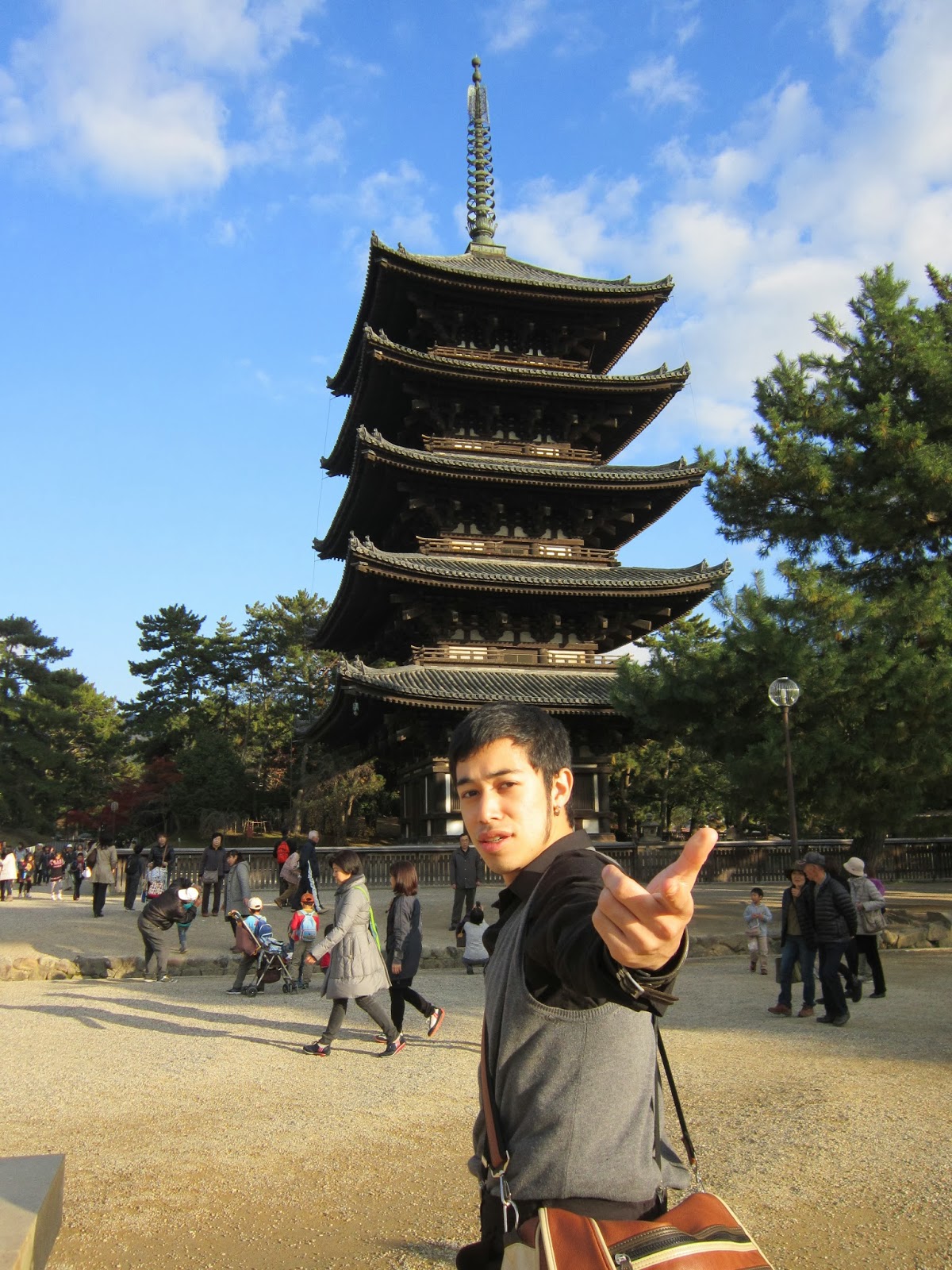
Worthy of notice is the Kokufuji temple and its 5-story pagoda, Japan's second biggest after the one in Kyoto (which I've also been to!) It's easy to catch sight of, given its proximity to one of the main streets. The temple's main golden hall is currently in reconstruction until 2018, and you bet your ass that it's going to be worth seeing at that point, if food shortage hasn't destroyed humanity by then.
 As a matter of fact, the whole area around Nara Park (which deserves an article of its own and will be getting one quite soon) is gorgeous and full of amazing sights. By gaining a little elevation, one can easily spot the rolling hills beyond the city, twice as nice in the autumn colors I had the chance to see them in.

Sarusawa Pond and its turtles
And of course, its only a few hundred meters from there to the lively city center. Sarusawa pond has a bunch of turtles and minnows in it, and its presence is quite soothing. You can buy turtle food at nearby trinket shops to try to feed them, but I'd imagine feeding a turtle is a lot like watching dust settle in your belly button.
The shopping streets are filled with Nara-themed things, and it appears that their college basketball team is called Bambitious (Bambi+ambitious) which is the single worst portmanteau in the existence of mankind, but not inappropriate. You'll know why soon. I'm not done with Nara.

Sunday, August 18, 2013

Kasai Rinkai Koen


Summer's been raging on with furious Tokyo heat and most of my friends have undertaken various trips outside of the country. I really had no excuse not to check out Kasai Rinkai Park, located a 10 minutes train ride away from my mighty apartment of Hermit Fortress.

 Actually, the park is also one station down from Disneyland, which unfortunately kind of puts it in its shadow. Lots of people actually haven't heard of this place, despite it being, you may quote me on this, probably the best park I've been to in Japan. It's actually pretty awesome. (And yes, if you put 2 an 2 together, I live 12 minutes away from Disneyland. Surprise! And I still haven't gone yet.)
 There's enough here for you to spend the day. Complete with an aquarium, a birdwatching area and a giant Ferris wheel, the park really has a little something for everyone, be it couples, families, or the odd guy who'll do it solo-dolo.
 I didn't go into the aquarium, which apparently features tuna a lot. I guess that'll come in handy when the species go extinct from over-fishing and they have the last 10 or so. They can then sell them to a rich Japanese guy for loads.
How awesomely scenic!
Personally, the birdwatching area really took me. Surrounding a vast marsh, the area is protected by wooden enclosures through which people can look. Some of the birds will actually come pretty close! There's a whole variety as indicated by the various signboards adorning the place, but it's a bit of a sport for the patient man, which I only rarely am. Still, in the 40 minutes or so I spent, I did manage to catch sight of a few bird-things here and there. (No really, I don't know what's what. Anyone care to help me identify the thing on the left?)

The view from the Diamond and Flower Ferris wheel
 The Ferris wheel, named the Diamond and Flower Ferris wheel after its decorative illuminations, was the world's second tallest at the time of its construction in 2001 (it's still 10th now and the current tallest in Japan) and provides a good view of the surrounding area - including the Disney resorts. From what I gather, you can also see Mount Fuji on a clear day, but I had no such luck. Its whole rotation takes 17 minutes, which is advertised as "maximum kiss time." That's pretty cheeky.


And that was my tour of Kasai Rinkai Koen! Go there! It's nice!