Showing posts with label Tochigi. Show all posts

Sunday, May 24, 2015

A Tochigi Day Trip - Part 3 - Kayabuki Tavern

I confess, when I originally planned the whole Tochigi day trip thing, I planned it around the one place I knew I absolutely had to visit. I made my 7PM reservation for the Kayabuki tavern a week early, and then realized we would be traveling on train a total of four hours, which seemed a little excessive. It was only then I thought of filling the day with a whole lot of other activities.
 So what's so special about the Kayabuki? The food's good. Also, two of the waiters are monkeys.
 That's right. Two of the waiters are monkeys.

Fukuchan isn't exactly light.
The Kayabuki tavern's owner has had pet monkeys for over two decades. At some point it occurred to him to have his pet monkeys, which could already do simple tricks, bring customers items such as hand cloths and simple orders such as beer. The idea was a success, and now Kayabuki has been featured on television shows around the world. Having met the monkeys personally, I can assure that Fukuchan and Yacchan are both very real and have lost nothing of their wild demeanor during their years of service to the tavern. They're well-trained and know to behave in the presence of customers (though they do occasionally howl and scream and jump.) Their offspring, though present within the tavern, haven't yet earned the right to become waiters, and are still in training.
 In order not to put too much strain on the animals, the monkeys are only allowed to work two hours a day, during which they dress in uniform. As I wrote above, the monkeys are extremely well-trained and put on shows for customers at certain times, where they jump through hoops and do other similar tricks, though I haven't seen this for myself. Allegedly, Fukuchan is also 4th Dan karate practitioner - though I'm not sure how this is possible.

Millo notably unamused to be kept waiting.
 Our experience at the Kayabuki tavern wasn't all smiles and laughter, though. As it turned out, the tavern was unusually crowded on that day, and it was plain to see that they were short-staffed. Being that this was the case, there was no way for the staff to effectively bring out everyone's orders and handle the monkeys at the same time, so we didn't get to experience the monkey waiters firsthand despite having sat there for two and a half hours. We were quite disgruntled by the time they did actually bring out the family of monkeys, and when they did, they offered customers only private time with them and the cost of 1000¥ per person.


 Unwilling to leave Utsunomiya without making contact with the monkeys, we gladly paid for the private session, which almost every other patron in the restaurant did as well. No doubt we would have not even had a turn if Ken hadn't told the staff we were in a hurry to get back to Tokyo. Despite the shortness of the time we had, it was hard to stay disappointed after that. Not only did the monkeys not mind the presence of people, but they seemed to actually love it. We had barely even sat down with them that they were jumping on our shoulders and into our arms, with the children being especially affectionate. Fukuchan, head of his family and largest of the bunch, was eager to impress and constantly challenged us by opening his mouth wide and showing his teeth if we made eye-contact with him, but he remained docile and offered lots of handshakes. Meanwhile, the owner gave the monkeys a variety of masks, which they wore without much complaint but eventually took off when they grew tired of.
 By then it was already time for us to return home after our eventful day, satisfied that we had seen a side of Tochigi that we hadn't, until then, known existed.

Friday, May 22, 2015

A Tochigi Day Trip - Part 2 - Oya

We hadn't spent much time in Utsunomiya before we decided to move out of the city and into the adjacent town of Oya. To be frank, when I first planned the road trip, Oya was meant to have been more of a distraction than anything else, but the cozy town turned out to be so much more than that.
 Oya is the exclusive place where Oya stone can be found. It's a unique rock that pretty much put the town of Oya on maps. Within the town, there are countless monuments made of it, and blocks of it seemed to have been carved right out of cliff faces, giving the landscape a bit of a peculiar look.

The Oya-ji Temple and the Oya Kannon.
Our first stop in Oya was the Oya-ji temple, a Buddhist temple with a very ancient history. The temple itself is nestled in a cave-like depression in a rock made of Oya stone. Upon entering it, a 1200 year old Kannon Goddess can be seen carved into the face of the rock. You're not supposed to take pictures of it, but I sneaked one for the sake of satisfying the curiosity of the few readers I have. Other figures are also carved into the rock, though notably not as important as the Goddess herself. Ken noted that there were words inscribed into the stone next to each respective figure, but the writing looked so far removed from Japanese that I couldn't help but wonder at the evolution of the written language.

The Heiwa Kannon and some unphotogenic Adventure Friends.
 Across from the temple, though nowhere as ancient as the Oya Kannon within the cave, is the Heiwa Kannon, another Goddess carved out of the indigenous rock. Overlooking a square, the Heiwa Kannon is much taller, standing at nearly 30 meters in height, and an impressive sight in and of itself. From what I've read, it was carved by hand as a World War II memorial. There are steps allowing visitors to climb up to its head, and give visitors a good view of the Oya-ji temple. We promptly did that, and, lo-and-behold, what we discovered from up there turned out to be even more interesting...
  A haikyo! We told ourselves we'd get back to it later, since we had one more thing we wanted to check out within the town. I'll elaborate further down.

All credit to Agha for this brilliant picture. It's hard to make Ken look like a child molester but he pulled it off.
 Our next stop was the Oya Stone Museum. And though my companions originally weren't sure what
to think of a museum based on stone, they were open to the idea of checking it out, and it sure as hell didn't disappoint. Essentially, the museum itself is a gigantic cavern. Located deep underground, the dark, cavernous halls of the museum were approximately 15 degrees colder than surface temperature, and we could see warmth of our breaths in the dim light. The cave turned out to be one of the highlights of our trip despite our initial skepticism. It was hard not to be amazed by the vastness of the underground chambers located under the small building on the surface. The walls were so high that the ceiling above was plunged into darkness. The whole thing felt very much like some kind of Egyptian tomb. Here are there, small art installations were installed and lit up in colored lights. We later on found out that many different music videos, commercials, and movie scenes were shot within these very halls. Some parts of the cavern were barred off and inaccessible, making it hard to tell how deep the man-made tunnels even went. We left the museum pretty satisfied with what we had seen.

 Thereafter, we took our bikes to the abandoned place we had seen earlier, from the top of the Heiwa Kannon statue. It took a little research for us to find out that the ruins before us were those of the abandoned Yamamoto Grand Center, which had been left to ruin at some point during the '80's (not a hundred years ago, as one of the locals tried to get us to believe.) The surface of the decaying structure was covered in vines and other various plant-life, so deep the ground-level of the building could hardly be seen. The tall grass was a nest full of vipers, as was made evident by the nearby signs. Though we were in broad daylight, we promptly decided to ditch our bicycles and find a way inside the building, but as we approached chains barred our way, alongside with a camera and another sign warning trespassers of an alarm. I swear to God, a pheasant also jumped out of a bush and scared the shit out of us, and so we decided it wasn't in the cards for us to visit this place, and we turned tail. Maybe some other time.

 Evening was encroaching on us by then, and we still had one appointment left, back in Utsunomiya. In fact, what came next was the very reason we had even come to Tochigi in the first place.

Wednesday, May 20, 2015

A Tochigi Day Trip - Part 1 - Utsunomiya

Utsunomiya - the Nashville of Japan, located in Tochigi prefecture, an hour and a half away by train. Yes, it's a modern city, but really, no one would go out of their way to visit it. It kind of tries hard to be something and puts upon a pedestal what simple areas of cultural significance it does have, no matter how minimal or insignificant. And even so it doesn't have all that much. If anything, it suffers from its prestigious neighbor, Nikko, which by anyone's standards is a lot more interesting. It's no wonder travel guides often skip Utsunomiya.

 But there are hidden nuggets of awesome to be found here, if you chance to look around! And so, the Adventure Friends of the day, Millo, Agha, Ken and I, tasked ourselves with the seemingly daunting mission of making a good day trip out of Utsunomiya and its surroundings.
Step 1? Rent a bicycle. You wouldn't believe how incredibly cheap it is to rent a bicycle for a whole day. The following is no typo. It's 100¥. There are no zeroes missing there. You can even return the bikes as late as 9PM. It's the perfect way to go out and about a decent sized city with interesting things few and far apart. With a price like that, cabs, buses and the subway just don't compare. We had no trouble getting ours after asking at the information kiosk at the JR station from which we had arrived. It only took a few moments for us to be upon our trusty new steeds, off to explore the city.


A chart of gyoza along with our lunch.
Utsunomiya is actually the capital of gyoza, or Japanese dumplings (though no one really calls them that.) There's no real getting around that, so a gyoza lunch was the first thing we got off our list. Well, we tried to see how deep the rabbit hole went by going into a food court where every shop specialized in gyoza. And we found it to be pretty god damn deep. Every variety of gyoza you could possibly imagine could be found in that one spot - and most likely a few you could not possibly imagine were as well. Tea-flavored, anyone? Shrimp? Or yuzu - you know, that sour citrus that only grows in East Asia? No? Didn't think so. Maybe Utsunomiya deserves its name as gyoza capital after all.


After lunch, we headed right downtown to the Futaarayama Shrine. Sure, it's no Meiji-Jingu, but the shrine is built on quite an attractive hill, almost right in the center of the city. It's hard to stand from the street level, look up at the shrine past its large torii gate, and not think it beautiful. We climbed the steps and paid brief visit to the shrine grounds, but found it to be nothing exceptional. Still, it's not without its charm, and some areas off the side of the central building itself were surrounded by beautiful trees, creating quite a nice and cozy little atmosphere. Still, the shrine and its surroundings do look the best from a little distance away, I thought.


 We hopped back on our bikes and made our way to the Utsunomiya Castle Ruins next. Here's what you should know about the Utsunomiya Castle Ruins: skip 'em. Really, there's little more than a wall and two turrets left. Again, these, too, look better from afar, but that's not even saying much. I couldn't figure out a way to even take a picture of the ruins that could make anyone kind of give a damn, and that's something I don't ever really recall saying before. So never mind them.

 Though it may not have seemed much, at this point we had already decided we had seen what we needed to see of Utsunomiya. Gasp! But wasn't this supposed to be a day trip? Fret not - our bicycles took us next to a place beyond the city borders. A place which was, I would say, exponentially more interesting. Thirty minutes and nine kilometers away, we came upon the second part of our day trip - the provincial town of Oya, and a small, very different adventure in and of itself.

Thursday, May 1, 2014

Western Village - The Theme Park That Was

When it comes to Haikyo, I usually opt for the overnight option. I'm comfortable going at it in the dark, away from the eyes of those who would think me suspicious. But I admit there are sometimes when the place in question is too interesting, or unique not to see in the light of day. Let me take you through my first time exploring an abandoned theme park. This is Western Village.
Millo, myself, Nana, Basil.
 Coming along with me for the trip this time around are a few familiar faces. There's Basil, my guest here in Tokyo (who, by the time this has been posted has returned to Canada), but also Millo and Nana, who have each been to one of my previous raids (Kappa Hotel and Nichitsu Ghost Town respectively.) It's a fun team and one I'm glad was willing to trail along on this crazy adventure.
 Going in, I knew close to nothing about the Western Village theme park - but I did know where to find it. Geographically speaking, it's only one train station away from Kinugawa, where the Kappa Hotel was located, in the mountainous Tochigi prefecture. I had a picture of Google Maps to guide me.
 Getting into Western Village was not an issue. All it took was a little climbing and we were already in - and in a place so deep in the middle of bumfuck nowhere, there was no risk of any one seeing us. And once we were in, the fun was set to begin.

That's the old Georgia state flag! No racism intended!
They're kinda dorky looking.
 Western Village was a theme park that delivered on exactly what its name implied. Just as the nearby Edomura theme park (which is still running) is based on the Japan of the olden days, Western Village mirrored it in being based on America's Wild West.
 In its heyday, cowboys strolled around, interacting with the park's visitors. Animatronic puppets, powered by pistons and other sorts of clockwork, could be spotted inside practically every one of the park's numerous buildings. And they still can, though they haven't moved since 2007.

 The beautiful thing about Western Village in its state of abandonment is that everything that could've been taken away has been kept exactly where it was by the park's staff. Of course, this is nothing unusual when it comes to Haikyo, but this is a theme park. It was nothing short of amazing to open a door and find what could have easily been 30 to 40 different costumes strewn about the room, dusty, but otherwise completely undamaged by the elements or moth or rat. It was time to dress up.

Everything we needed to take these pictures were found on spot.
 A light reflecting screen here, a fire extinguisher there, and as many props as we wanted to use.
There were so many combinations possible and I felt like I could have spent hours dressing up with the team and taking zany pictures. The park was ours - where else would we have ever been able to shoot off fire extinguishers just for the sake of creating the haze we needed for a nice shot? Haikyo is a thing of beauty. Hell, I even dressed up as one of the park's mascots. That costume was intact too.
We found the largest building in Western Village to be a large hall full of two meter tall teddy bears, standing around and wearing all sorts of patriotic clothing. Stars and stripes in abundance, really. The second floor was filled with what was once fare games, and the third was somewhat of an Indian (as in, Native American) museum. But upon exiting the building through the other side, we came upon Western Village's defining feature: an enormous replica of Mount Rushmore. The entire thing was hollow rather than made of stone, and it's only truly dawning upon me as a write how much effort must have gone into the opening and maintenance of this park that would eventually just be abandoned and left to sit in silence.
 I resolved to do yet another thing that couldn't be done if the park were still running today, and stood upon the head of George Washington victoriously.

God I feel like I've lived.
 Western Village may not be as immense as Disney Land or FujiQ Highland, but it's no tiny little fairground either. Arcades, gigantic dining halls, a haunted house, watchtowers, a ranch, a kids' train line, and a mini-golf course are all included in the package, and that's really just the half of it. It's no wonder our day went by so fast.
 In the end, though, it doesn't take a genius to guess what did the park in - location, location, location. Take into consideration that the two aforementioned theme parks are both much closer to Tokyo than Western Village was. With such powerful competitors, how could this theme park ever hope to stay in business while operating from a tiny town in Tochigi prefecture? Kids will choose Disney over cowboys any day of the week, and this park used to count only on its theme to tide visitors over. Notice that there are no roller coasters or thrill rides in Western Village. The place probably ran into debt and stumbled into bankruptcy shortly after.
 Looking only at the facts, it may not be long until the neighboring Edomura park finds the same problems. And I may chance to climb upon its remains after the fall. 

Monday, April 14, 2014

Kappa Hotel: Up Above and Down Below

As the night stretched on, so too did we speed up our exploration. We were no longer stopping in every individual hotel room. It was time to head straight to the important points - and with the map in hand, finding each of the interesting locations was a breeze. We hit our destinations with good speed as made our way through dining halls, lounge rooms, a billiard room and a table-tennis room.

Anything here?
 Though elevators were once a valid way of getting around, with the power grid being off, it was the stairs all the way for us. It was no sweat finding an emergency staircase to lead us all the way to the roof. By this point, we had already found out that, inside the hotel, every door would open to us. It was just a matter of picking which doors to open. When we came out into a dark, quiet night, nothing but the sound of the river raging below broke the silence of the sleeping town.

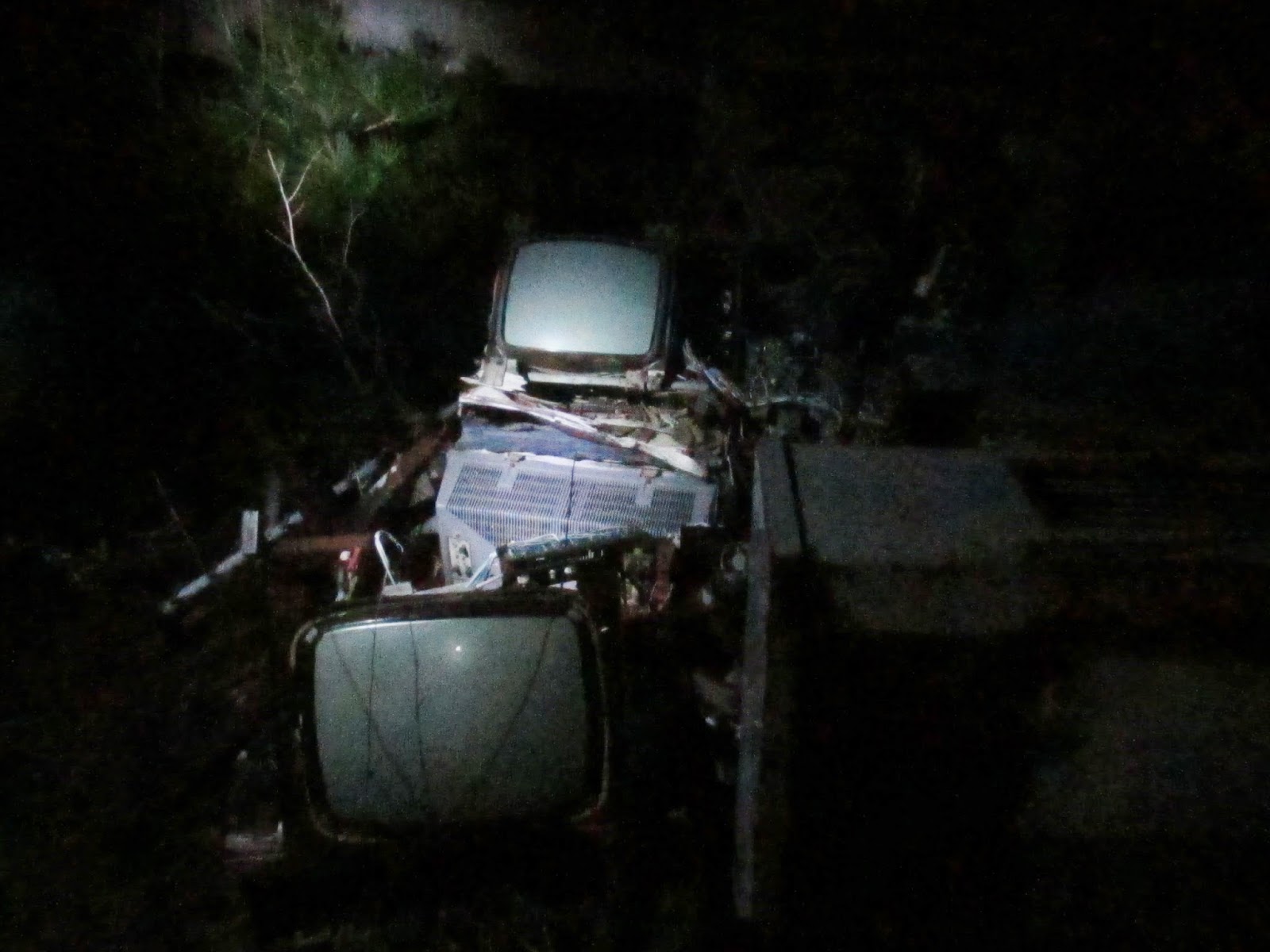
Discarded analog televisions and karaoke units lined the way to the rooftop, further cementing into our minds how much time had stopped since this place was left unattended.
 Unlike some hotels in the very same region that had baths installed at the highest place possible, Kappa Hotel had nothing much going for it on the roof - but for the view upon the rest of Kinugawa.
What was I expecting to see?
Having scouted the way up, we now knew that the next destination was down. But we knew we hadn't seen the last of this roof.
And so we backtracked and took the staircases lower than where we had even started. One item on the map in particular had me curious, reading "Kappa Country."
 It was with great surprise that we found it to be an arcade, and a sizable one at that. Nostalgia took us. Would that we could've shipped a whole console home.
 We paused here only briefly though, before the rest of our descent.
 Along the walls, guide arrows lead us to our next destination: the baths.
Being that the Kappa Hotel was situated in an onsen town, and given the sheer size of the place, it almost seemed only natural that it would have six bathing halls. The state they were in when we found them, though, was less than pitiful. Ornaments had been smashed by previous explorers, and we even found a dead rat in one of the baths.
 By far the biggest bath was the Kappa Bath, remarkable also with its small Kappa ornaments staring back at us as we explored the room.


Legend had it that these amphibious monsters were notorious for stealing children away, drowning people and their animals, and even rape. They were regarded as a form of imp or demon, but they're much more iconic nowadays. Even still, it's no wonder this place is so popular with the urban exploration community in Japan. The room would've been a little creepy had I been alone.

Most of the other buildings are also hotels.
It was growing late. We took a break at this point, and even a short nap, before heading to the very top of the building once again. All went according to plan.
As the clock struck 5', we stood atop the abandoned hotel and caught sight of the town in its waking hours during the sunrise. The exploration had left us tired, and we watched as people came out on the roofs of other hotels to take baths. The clean mountain air mingled with the smell of rust from the roof's railings.

We were just about ready to leave the hotel to its loneliness when we decided to have one last peak at the Kappa Bath again, wondering what it would look line now in the light of day.

The beautiful thing about Haikyo is not having to share.
With such a nice view on the woods, the cliffs, and even the river, if one got close enough to the window, it's a bit of a shame that the Kappa Hotel was one amongst the handful of hotels to close down in Kinugawa. Had it still been running, the Kappa Bath by itself would've been enough to make the place the talk of the town, it seemed to me. But one only understands so much by visiting it after its fall.
See you next time, Kinugawa.
We were exhausted and our clothes were filthy by the time we left. Bumbling out of the hotel, we tried to find our way into a hard-earned bath, with no success whatsoever. The hotels still running wouldn't let us use theirs (some do, though apparently not in this town) and other places wouldn't open in three hours still - which wouldn't give Millo enough time to get home for work.
Damn! What a bummer.
We stumbled onto the train and slept the way home. One more Haikyo off my checklist.

Thursday, April 10, 2014

Kappa Hotel: The Middle Floors

The supper before the deed.
 The plan was simple - to take a train to Kinugawa Onsen town, arrive in the dead of night, grab a quick bite, stock up on food and provisions, spend the rest of the night in the haikyo, and find access to the rooftop by the break of dawn, and watch as the sun rose upon the town. And maybe explore a little more afterwards. Of course, we'd top it all with a soak in the hot bathes of Kinugawa.
I geared up - flashlight, camera, first aid kit, and warm clothes, and met Millo in Ueno station, and we headed for the mountainous Tochigi prefecture.


 The ride there was somewhat of a confusing mess, but when we did emerge in Kinugawa Onsen station, even later than we thought we would, light snow was falling. We stocked up on easy-to-eat food in a convenience store, and followed the river up to our destination: Kappa Hotel.
The place was a gigantic megaplex of a hotel built on the side of a cliff - two wings connected by a central building, each wing eight floors high, and most of all, in a visible state of decay. Once upon a time, it must've been a really majestic building, but it was abandoned in 1999 due to a decrease in tourism, and left to fall apart where it stood. Finding our way in and through wasn't an issue at all. We were more concerned about whether we would be able to go through the whole thing in the time we had.

It won't be long before this one's overgrown too.
 We entered through the ground-level floor, easily finding a sliding window that would let us in within the first five minutes of arriving on site.
 I say ground-level floor, but truly, this was the fourth. The floors below descended into the cliff, deep in the shadow of the valley.
 As one would suspect, after 15 years of decay, the ground level floor was blasted to hell by the elements, and this would be the one floor in the deepest stage of being taken over by nature again, with weeds growing out of the very cracks in the floor, and the boards of the floor itself completely rotten. We fell through several times, hitting the foundation of the building itself and thankfully never getting injured in the process.
But we knew this floor was only a tough passage into the more interesting floors above - and eventually, below.
The west wing staircase was not as hard to find as it was to walk to, with the floor giving way beneath us, but we managed.

One of what could've been 50-70 similar rooms.
Making our way up, we arrived upon troves of interesting rooms, giving us a peek at what the place must have been like in the past. We darted in and out of the traditional tatami rooms of the hotel, still fully furnished with chairs, bedding, tables, framed paintings, fridges, each of which even was filled with old alcohol. Hallways too cluttered with debris made us go through balconies to clear rooms. But in walking through the rooms as so, we found some inside which practical guides to the hotel still remained. And inside such a guide, one inevitably finds a floor map. I held onto that.

The invaluable map. I was thankful I could read enough to understand all this.
Once a clubroom.
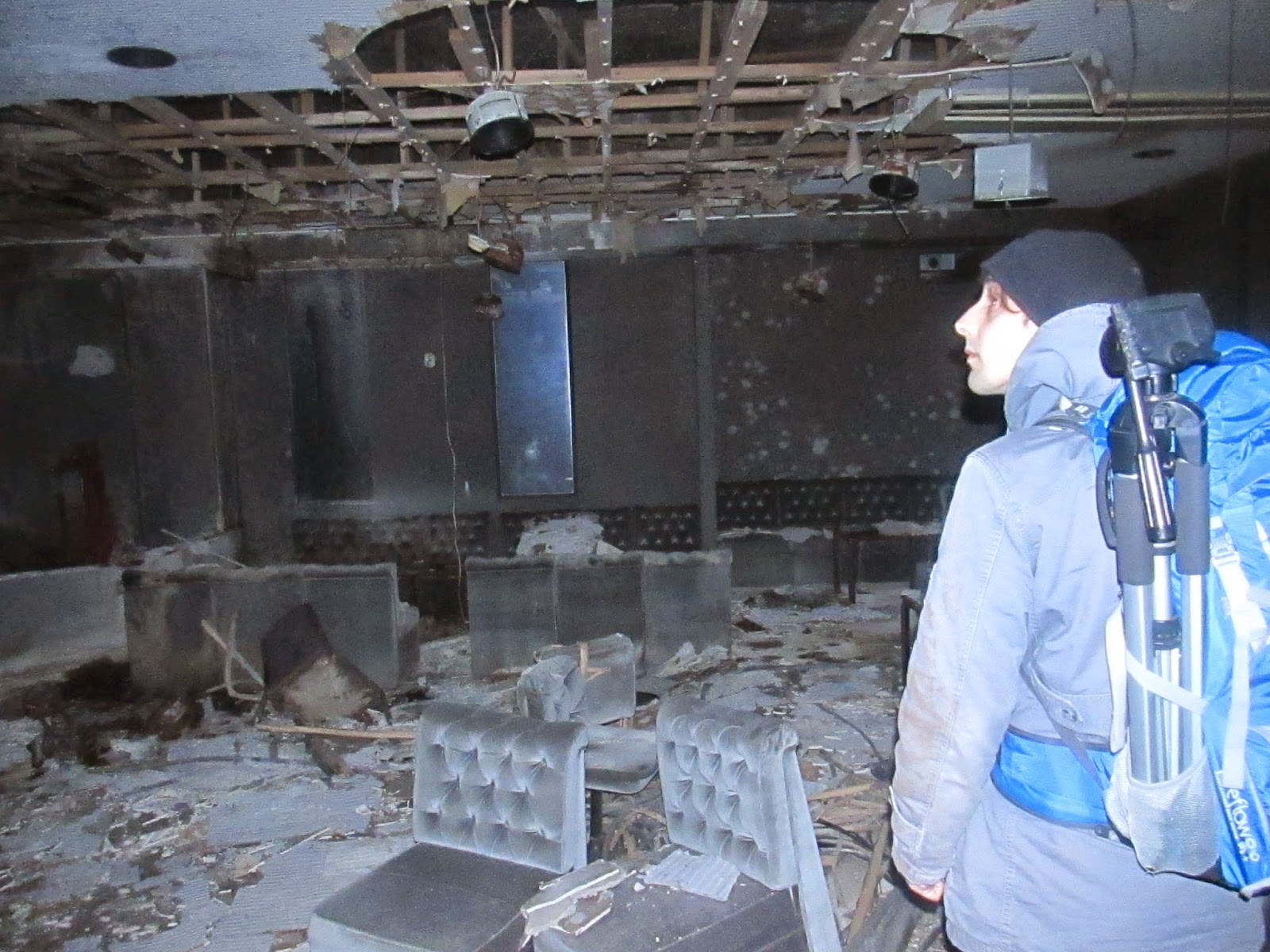
Using the map, we easily found the rooms we were hoping to stumble upon that might have taken us quite a bit of exploration otherwise. The banquet hall, with its cafe and bar clubroom formed the bulk of the central and west wings of the fifth floor, and truly, these rooms must've once been grandiose. Pictures of the very banquet room we stood in lay inside an album on the bar counter, showing us scenes from the past where the hotel was bustling with visitors. But now, there was so much clutter and overturned tables and chairs that it was hard to make our way through at times - a fact made worst by the darkness.

 When exploring haikyo, vandalism is the only certainty, so it was par for course that tables would be overturned. Messages written on the walls, such as "this is a place to die" or simply, "die, die, die" were something we had expected. Other messages were just interesting or even entertaining: "this room is sweet!" it said on a door, and at one point "this is the Master Key" a message said, with an arrow pointing at a dangling key.
 Of course, names of people and dates were written all over by groups that had cleared the haikyo before us.

But what truly was disturbing was that which was just plain unusual: in one of the bathrooms, hair was scattered across the floor - intentionally cut, by the looks of it. Whether it was a person's or a doll's couldn't be told from a mere look.
 And then, it was on the sixth floor that our flashlights caught sight of antlers. Surely the layout of the place was tampered with - there was no other explanation as to why there would be two petrified stags in the middle of a hallway.

There are two in this picture.
For fear I'm dragging on too long for a single article (at least where this blog is concerned) I'll stop here, but all this is only half of what we've seen in Kappa Hotel. The very top and the very bottom floors still beckoned to us, and I'll go on about that soon enough.

Saturday, February 23, 2013

Nikko - Sunlight City

Before my former roommate Julien "Shank" Einschenk left Japan, he went on a pilgrimage of sorts to hit all the most beautiful historical sites that the country had to offer. It was then that I had first heard of the city of Nikko. Shank, he wasn't really the talkative type, but you could almost see the glimmer in his eye when he spoke of the city in the mountains.
 And now I know for myself that Shank was right.


It had been a while that I had discussed going to the city with Mori, who has been working hard to save the money needed to travel the world once more. Ken, always willing to set out for new places, was quick to join along, and our waltz was complete, our destination, set. We headed north to the mountainous prefecture of Tochigi and arrived two hours later in the much colder, and quieter, city of Nikko.

I have to tell you right off the bat that if you expect to eat anything in Nikko other than yuba (that's ゆば in Japanese) then you're fucked. The tourism overlords of Nikko seem to take great pride in the local speciality dish that is yuba and will stop at nothing to cover the city in restaurants and billboards with yuba upon every corner. "The hell's yuba?" you might ask. Well, according to wikipedia, it's tofu skin. Pretty simple, I think, but local restaurants seem to take delight in preparing it in many different ways. Yuba's okay, I guess. It's not a particularly rich taste. But for such a statement I may get a stone thrown at me by the very people who use it for the preparation of lavish dishes, dessert, and even ice cream in Nikko.


 But it's not the nature (nor the food culture) that makes Nikko's beauty, although it certainly does contribute into it. In the religion of Shinto, Nikko is effectively the birthplace of a God. A Shogun, one of the de-facto rulers of Japan, died in this place, and was there after deified and given a grave fitting for that of a God. If Nikko was any holier than it it is, then surely I would've burst into ashes on the spot. And in no place is this more apparent than that very grave: the Nikko Tosho-gu.
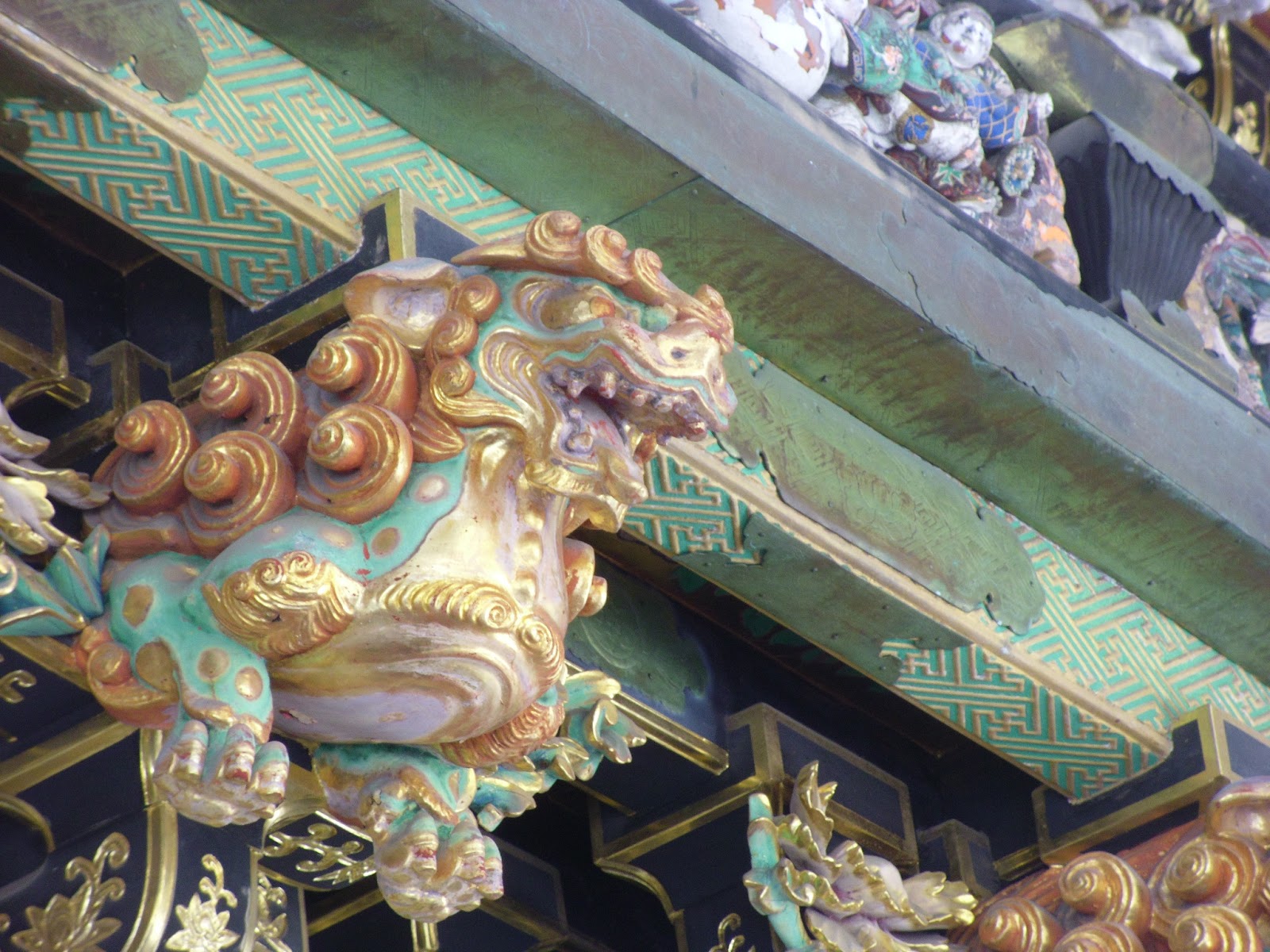
It would take a real philistine to not appreciate the sheer enormity of the mausoleum of Tokugawa Ieyasu, from the mere path leading towards it to the detail in every relief, every idol and statue. A tremendous amount of gold was used here not only in reverence of the shogun-turned-God, but to show the whole world a demonstration of the wealth and power of Japan. 2 million sheets of gold leaf were expended in the creation of this mausoleum - that's 2.4 hectares of god damn gold leaf. On top of that, it took 15000 artists and craftsmen from all over Japan to bring the mausoleum to its completion in the 17th century. I hope they fed them more than just yuba.
 It's in Nikko Tosho-gu that one can fully appreciate icons famous in Japan's mythology - take for instance the fresco depicting the Three Wise Monkeys, Mizaru who sees no evil, Kikazaru, who hears no evil, and Iwazaru who speaks no evil. Yeah, this is the origin of that.
 Five of Japan's national treasures are located within the territory occupied by the Nikko Tosho-gu.
 Without exaggeration, I feel like one could easily spend half of a whole day to appreciate all there is to see within the grounds of the mausoleum, but it took Ken and Mori and I the better part of an hour and a half or so. In all frankness, though, it takes more than mere pictures and words to convey the majesty of Nikko Tosho-gu. It's world class beauty, maybe even more so than anything else I've seen in Japan.


Frankly, there's a lot more to see in Nikko than we managed to get ourselves to do. From what I hear, a number of beautiful gardens and other temples and shrines adorn the city, including that of the shogun's grandson, even, but what are those when compared to the birthplace of a Shinto God? Although we did visit the imperial villa, it turned out to be a little underwhelming, I felt (but it is a big-ass house.) And so, our journey to Nikko ended with the three of us going into one of Nikko's hot springs, after which we took the train back to Tokyo. (And then we sang karaoke!)

 Here's a photo-roll, because there was no way I could fit all the pretty sights into this one blog post!